Corporate soccer teams in Miami are changing how the city’s best companies build culture. And it’s not happening in a boardroom.
The best team-building activity in Miami isn’t a cooking class or an escape room. It never was.
What’s actually working right now — what’s building real trust inside companies from Brickell to Wynwood — is simpler and more human than anything HR has packaged into a slide deck. Companies are fielding soccer teams. Not as a wellness checkbox. Not as a PR gesture. But because someone in leadership finally admitted what most of us already knew: the real culture gets built outside the office. It always has.
Miami Is Growing Faster Than Its Culture Can Keep Up
Something structural is shifting in this city.
In 2024 and 2025, more than 30 major corporations relocated or significantly expanded in South Florida. Microsoft moved its Latin America headquarters to Brickell. Amazon took the largest office lease in Wynwood’s history. MSC Group built a U.S. headquarters campus in Downtown Miami. JP Morgan, Santander, Citadel — the list keeps growing. Miami now ranks as the #7 financial center in the United States. They’re calling it “Wall Street South,” and the migration isn’t slowing down.
Here’s what doesn’t make the headlines: these companies arrive with their strategies intact, their systems in place, their org charts mapped — but their people don’t know each other yet. You can’t ship culture from New York. You can’t FedEx what took a decade to build in São Paulo. Culture has to be built from scratch, with the people who are actually showing up every day.
That gap — between a talented new team and a team that actually trusts each other — is the most expensive problem Miami companies aren’t talking about.
A corporate soccer team doesn’t just fill that gap. It accelerates it.
The Connection Problem No Office Layout Can Solve
Gallup’s latest State of the Global Workplace report says only 21% of employees worldwide are engaged at work. In the United States, that number dropped to 31% — the lowest in a decade. Disengaged employees cost U.S. companies $1.9 trillion in lost productivity every year.
But here’s the real story behind the numbers: the most disengaged employees aren’t the ones who don’t care. They’re the ones who never felt like they belonged.
IBM research puts it clearly — employees who feel a strong sense of belonging are three times more likely to be engaged. Three times. And belonging isn’t built in a conference room. It’s built in moments where people stop being roles and start being people.
Corporate soccer teams in Miami are becoming one of the most effective places in the city where that happens.
Thinking about building this for your team? [Talk to FCnoise →]
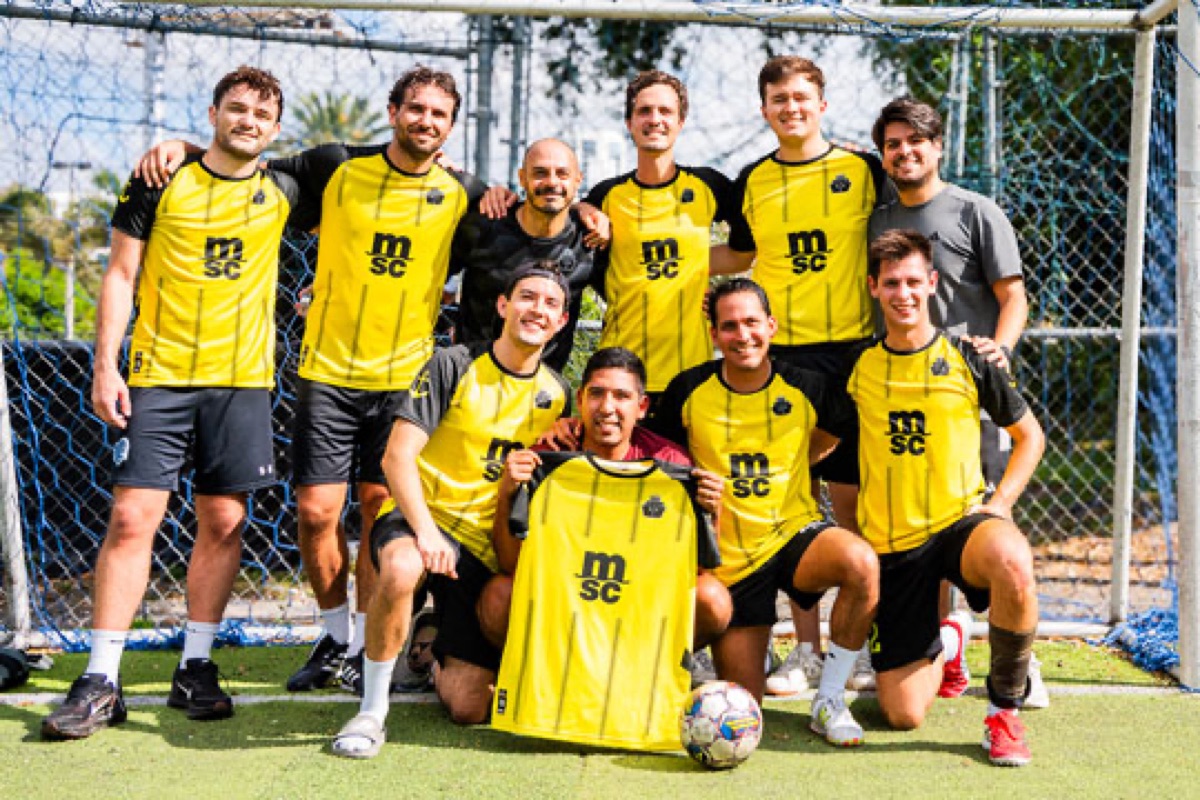
What Actually Happens When Your Company Fields a Soccer Team
Forget the theory. Forget the HR playbook. Here’s what people inside companies that have actually done this are reporting back.
They See Each Other Differently
An executive at EY described it this way: “You get to see people outside their natural habitat — a little more relaxed. Now that I play with them, there’s a nicer community at the office. This is as important as working.”
That’s not a wellness stat. That’s a relationship.
Something happens on a pitch that a team offsite in a hotel conference room cannot replicate. The mask comes off. The accountant who barely speaks in meetings turns out to be a midfielder with serious technical skill. The VP who seems untouchable at work is the loudest voice on the touchline, pushing his teammates forward.
You see the person — not the title.
And once you’ve seen that — once you’ve run alongside someone, celebrated a goal with them, lost a close game with them — something changes back at the office. You know them now. You know how they handle pressure. You know what makes them light up. And knowing someone makes everything else easier.
Corporate soccer teams in Miami aren’t just solving loneliness — they’re building the kind of familiarity that makes collaboration feel effortless.
Monday Morning Feels Different
A team leader at MSC described what happened inside their office once the team started playing: “Everyone is waiting on Monday to know what happened. It’s creating a great culture — they want to see the recap, even the ones who aren’t playing.”
Read that again. Even the ones who aren’t playing.
That’s the signal. When the culture extends beyond the players on the pitch — when the whole office becomes invested in the story — you’ve built something that no team-building event produces. You’ve given your company a shared narrative. A reason to ask each other “how was your weekend?” and actually mean it.
That’s not a perk. That’s retention. And retention is the most expensive problem HR leaders in Miami are trying to solve right now.
The Numbers Behind What You’re Feeling
For the HR leaders in the room who need the data alongside the story:
- 🏟️ Only 21% of employees globally are engaged at work (Gallup, 2025)
- 💸 Disengaged employees cost U.S. companies $1.9 trillion annually in lost productivity
- 🤝 Employees with strong workplace belonging are 3x more likely to be engaged (IBM)
- 📉 Organizations with strong engagement programs see an 87% reduction in turnover (Gallup)
- 🎯 “Purpose” is the #1 driver of retention — employees with it are 2.7x more likely to stay
The connection between building corporate soccer teams and these numbers isn’t theoretical. It’s the same mechanism: belonging → engagement → retention. The pitch just happens to be the best environment Miami has found for building that belonging quickly.

This Is Already Happening in Miami — The Corporate Fútbol League
Here’s what most people don’t know yet.
There are already 20 corporate soccer teams competing in an organized corporate soccer league right here in Miami. It started in October 2024. In one year, it grew 400%.
It’s called the Corporate Fútbol League — the CFL.
Why fútbol and not soccer? Because we’re in Miami. Inter Miami plays fútbol. The city plays fútbol. The language fits the culture — and here, culture is everything. The SEO says “soccer.” The soul says “fútbol.” Both belong in this city.
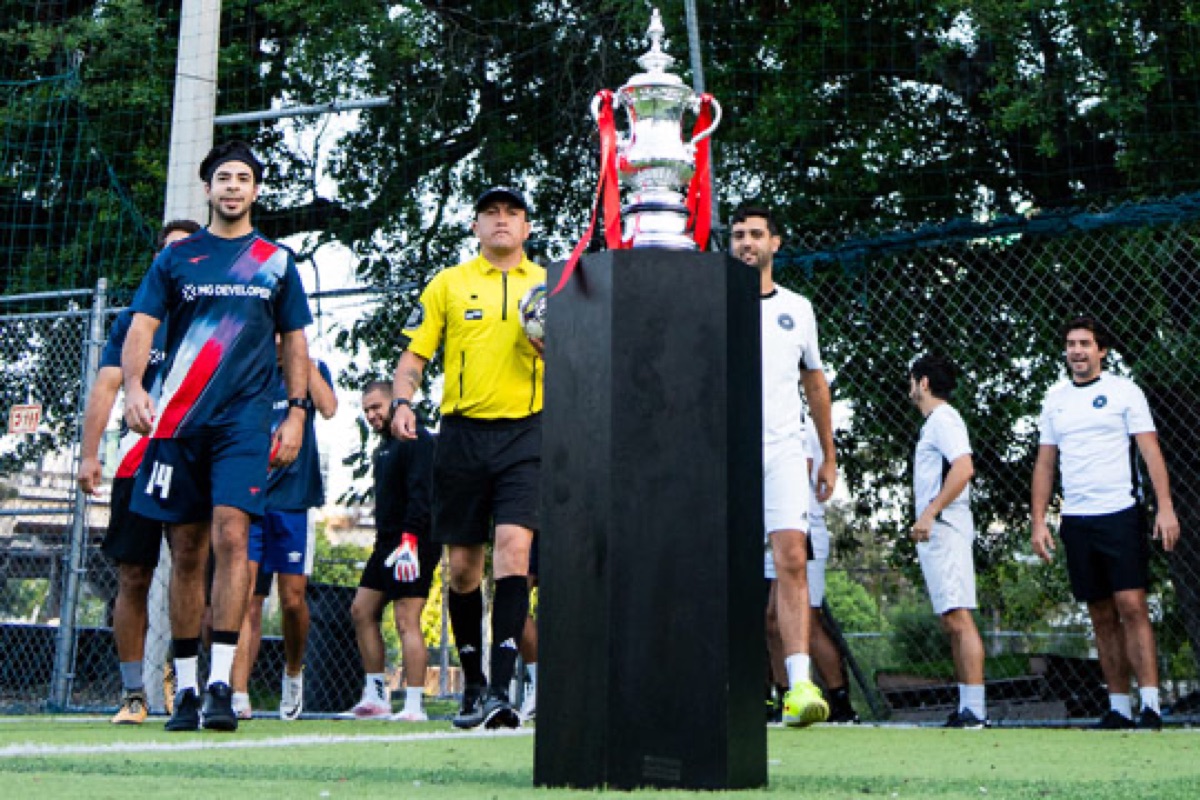
The CFL runs two full divisions — Division 1 and Division 2 — with promotion and relegation between seasons. There’s also the Orange Cup and the Super Cup, where all 20 teams compete together. Over 30 companies are represented. More than 30 nationalities on the pitch. Over 350 players and supporters gathering every Saturday.
Companies you already know: JP Morgan, Santander, Merrill Lynch, EY, MSC, Ocean Bank, FIFA, and more. Real games. Real standings. Real rivalries.
And it’s not only the pitch.
There’s a full league platform where players track stats, standings, and fixtures in real time. A weekly newsletter that runs a 60% open rate — because players are checking match recaps, following storylines, reading about their teammates. Match preview reels. Post-match reactions. MVP recognition every matchday. An end-of-season Awards Gala with a red carpet and business panels. Over 350,000 content views across the season.
This isn’t an event. It’s a living, compounding community.
In 2025 alone, $78K was invested in operations and development — because this isn’t a side project. It’s infrastructure for Miami’s corporate culture.
How to Field a Corporate Soccer Team in Miami — What It Actually Takes
This question comes up constantly. And the honest answer is: the barrier is much lower than most people expect.
Who Joins a Corporate Soccer Team
It’s not just the former college player who’s been missing the game. It’s the professional who played in their home country and stopped when they moved to Miami. The junior analyst who grew up watching but never had a competitive outlet. The manager who’s been looking for a reason to connect with their team outside of a performance review.
The common thread isn’t skill level. It’s the need to belong to something beyond a job title.
The teams that build the strongest cultures inside their companies tend to have the widest range of players — from technically sharp former academy players to first-timers who just wanted to try. That mix is the point. It’s the same mix that exists in your office, just finally visible.
What the Company Actually Provides
The investment is modest. To field a corporate soccer team in Miami through the CFL, a company typically covers: team registration, a set of jerseys with the company name, and the commitment of a Saturday morning.
That’s the full list.
No facility rental. No equipment budget. No event planning team. The league handles the format, the referees, the fixtures, the content production, the platform, and the community calendar. You show up. The experience is already built.
For context on ROI: most HR benchmarks put voluntary turnover replacement at 50–200% of an employee’s annual salary. A corporate soccer team costs a fraction of that — and it builds the exact kind of connection that makes people choose to stay.
Where to Start in Miami
The Corporate Fútbol League is the only organized corporate soccer league in Miami built specifically for companies — with full seasons, two divisions, promotion and relegation, a cup competition, and a professional content experience around every matchday.
The community is 20 teams strong. It grows every season.
Companies that wait will enter a league where relationships between rival teams are already built, rivalries have history, and the culture has compounding momentum. Getting in early matters — not just for the games, but for what the network becomes.
Your Questions About Corporate Soccer Teams in Miami — Answered
How Many Players Do I Need to Field a Corporate Soccer Team in Miami?
The CFL is designed for corporate schedules and squad sizes that fit company realities. You’ll typically need 8–14 players per team to account for the inevitable Saturday conflicts, travel, and busy seasons. You don’t need 25 committed players to start — you need enough people who want to play, and a company willing to back them.
Is Corporate Soccer in Miami for Professional Athletes or Everyday Players?
Corporate soccer teams are built for working professionals who love the game — not ex-pros or full-time athletes. The spirit of the CFL is competitive but inclusive. Skill levels across the league range widely, from players who grew up in academies to adults who picked up the game late. What everyone shares is showing up, working hard, and caring about the result. That’s enough.
What Is the Time Commitment for a Corporate Soccer League in Miami?
The CFL runs weekly Saturday games during the season. Most players are on the pitch for 2–3 hours on matchday. There are no mandatory training sessions — though teams that organize sessions together tend to form tighter bonds, both on and off the pitch.
How Do Corporate Soccer Teams Improve Employee Retention?
The mechanism is direct: corporate soccer builds genuine relationships between colleagues that go beyond professional transactions. Belonging is the #1 driver of employee engagement, and engagement is the #1 driver of retention. When your employees share a story together — wins, losses, goal celebrations, Monday morning recaps — they stop thinking about your company as just a job. That shift is worth more than most retention bonuses.
Are There Other Corporate Soccer Leagues in Miami?
The CFL is the only dedicated corporate soccer league in Miami structured around company teams, with full competitive seasons, divisions, promotion and relegation, cups, and a professional content experience. Recreational leagues exist for individuals. The CFL is where company teams play.
The Community Is Growing — Don’t Get Left Behind
Twenty teams is not a pilot program. It’s a community. And communities compound.
Every season the CFL runs, the relationships between players from competing companies deepen. The networks between professionals from JP Morgan, FIFA, EY, and Santander extend. The shared language — the results, the goals, the rivalries — becomes a cultural currency that travels beyond Saturday.
The companies already inside this have an advantage that grows every week. Their people know each other across industries. Their brand is attached to something people actually care about. Their culture has a story.
Miami is becoming one of the most important business cities in the world. The companies that will define its culture aren’t the ones with the best office coffee or the nicest views.
They’re the ones that figured out how to make their people feel like they’re part of something.
Corporate soccer teams in Miami are doing exactly that.
Is your company ready to field one?